

For decades, African farmers and manufacturers have played a frustrating game: dig it up, grow it, or craft it, then ship it off raw for someone else to make the real money. That script might finally be flipping.
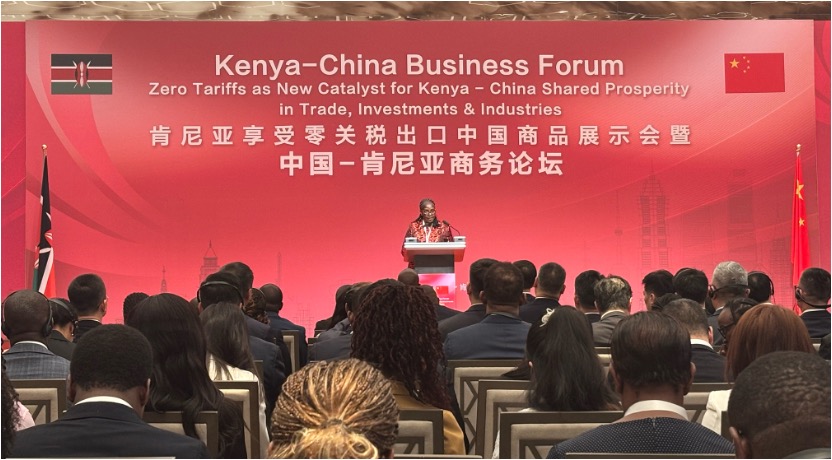
NAIROBI – There was something different about the train that chugged out of Nairobi on the morning of March 23, 2026. It wasn’t just carrying the usual containers of tea or coffee. It was carrying a promise. For the first time ever, a consignment of Kenyan goods was heading to China under a brand new zero-tariff agreement, and if the policymakers are to be believed, this is just the opening act of a continental economic revolution.
Come May 1, 2026, the full policy kicks in. China, the world’s second-largest economy, is granting 100% duty-free treatment to a staggering 98.2% of all Kenyan exports. And Kenya isn’t alone. This sweetheart deal extends to 53 African countries that maintain diplomatic ties with Beijing. That’s essentially the entire continent, minus a handful of holdouts.
So, what’s the catch? There isn’t one, exactly. But there is a catch-up game that African businesses need to play. For generations, the continent’s default trade strategy has been painfully simple: dig up minerals, pick fruit, or fell timber, then ship it all out raw. Let the Europeans, the Americans, and the Chinese do the processing, the packaging, and the profiting. This new policy from Beijing is designed to break that cycle, whether Africa is ready or not.
Regina Ombam, Kenya’s Principal Secretary for Trade, put it bluntly during a recent CGTN Talk Africa forum. She said the goal is no longer just to send more avocados to Shanghai. The goal is to send avocado oil. The goal is frozen avocado chunks. The goal is specialty teas in fancy boxes and branded coffee that tells a story. “That is value addition in itself,” she explained, and in the world of trade, value addition is just a fancy way of saying “more money stays home.”
Dr. Erick Rutto, who heads the Kenya Chamber of Commerce and Industry, brought the point down to earth with a simple example: flowers. Right now, Kenya ships mountains of rose stems. But if you take those same cuttings and turn them into a bouquet? “You increase the price three to four times higher,” he said. Multiply that across every sector—leather, textiles, tea, fruit—and suddenly you’re not just talking about trade. You’re talking about jobs. Real factory floors. A middle class.
But here is the sobering reality check that everyone on the panel agreed on. Africa has heard this kind of sweet talk before. Remember AGOA? That’s the African Growth and Opportunity Act with the United States. For 25 years, Kenya was supposed to have duty-free access to the massive American market for over 6,000 different products. You want to know how many they actually ended up exporting? Nine. Nine products. Dr. Rutto brought that stat up not to depress anyone, but to issue a warning: access on paper means nothing if you can’t get your act together on the ground.
So what went wrong before, and what could go wrong now? The list is boring but brutal. Chinese customs have strict rules about sanitary standards, pest control, and traceability. You can’t just throw some avocados in a box. You need to prove where they grew, what chemicals touched them, and that they won’t bring a single bug into China. Oh, and your labels need to be in Chinese. William Zhuo, the Chairman of the Kenya Chinese Chamber of Commerce, said the zero tariff is “very good for Kenya,” but then added the kicker: “If we don’t meet Chinese standards or requirements, it cannot benefit local small farmers.” His solution? Training. Lots of it. Farmers need to learn about packaging, about pest control, about the paperwork.
There is also the money problem. Retooling a factory to process avocado oil or freeze flower stems costs serious cash. Local businesses need access to trade finance and cold-chain logistics—fancy terms for loans and refrigerated trucks—and those are still hard to come by for small players.
But here is where the story gets genuinely interesting. Kenya isn’t just thinking about itself. With its Standard Gauge Railway and the busy port of Mombasa, Nairobi is positioning itself as the factory floor for all of East Africa. Zhuo laid out a vision that sounds almost too clever: imagine sourcing cotton from Tanzania, raw leather from Uganda, and maybe some minerals from South Sudan, bringing it all to Kenya’s Special Economic Zones, processing it into finished goods, and then shipping it all to China tariff-free. That’s not just trade. That’s regional industrialization by proxy.
Of course, that dream hits a wall called fragmentation. Africa currently contributes a paltry 3.4 percent to global GDP and barely 1 percent of the world’s manufactured goods. You cannot supply a 1.4 billion-person market like China when every neighbor has different standards, different customs forms, and different currencies. Dr. Rutto made the case bluntly: Africa needs to merge. One standard. One customs union. One currency. That’s the AfCFTA dream—the African Continental Free Trade Area—and it has never been more urgent. If the continent can finally link up its rail lines and tear down its own internal barriers, then and only then can it achieve the scale needed to truly feed China’s appetite.
For now, though, the first train has left the station. Literally. And for the first time in a very long time, African producers are being told they don’t have to just dig and ship. They can build, brand, and profit. Whether they seize that chance or let it roll past like so many empty promises before—well, that’s the real story still waiting to be written.